Stop 12: Ohligs Station
Bremsheyplatz – go to map – go to starting point
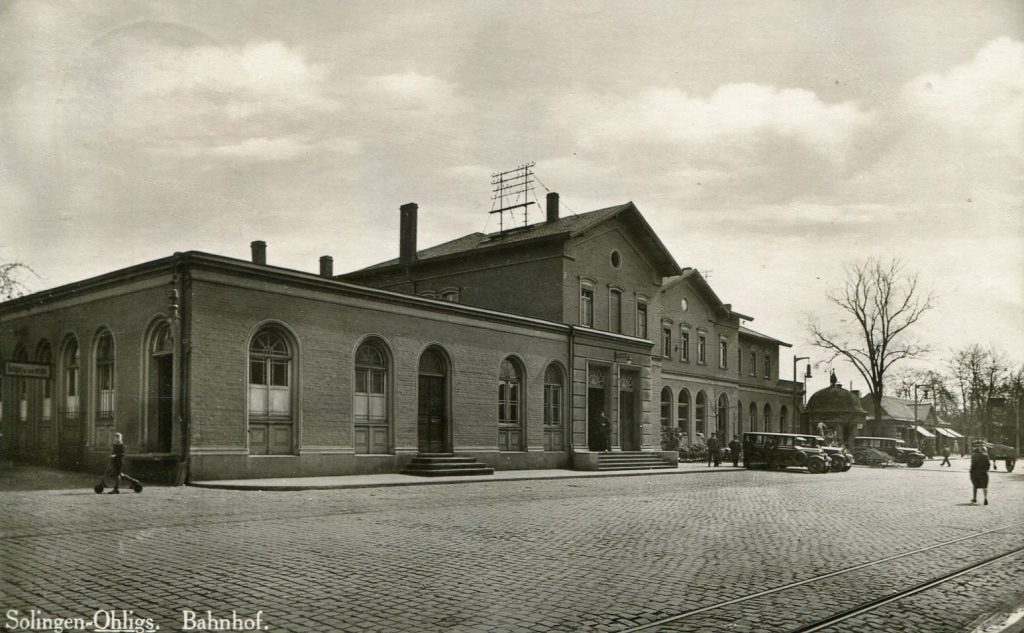
When the train station Ohligs-Wald commenced operations on 25 September 1867, the small village of Ohligs soon grew into a townlet. Its development significantly profited from the Jewish merchants that settled there towards the end of the 19th century. Along the new commercial street, extending from the station westwards, small department stores with ready-to-wear-clothing emerged: something that people had only known from larger cities before then. The local newspaper “Ohligser Anzeiger” was the preferred medium when it came to advertising special offers.
The Jewish merchants often brought a family network of business partners with them, enabling the purchase of goods at affordable prices. While most of their parents’ generation had still been cattle traders, they themselves mainly tried their luck in the textile industry. That way, they socially advanced towards the middle-class spheres and achieved some prosperity. As a consequence, they were in the financial position to invest in their offspring’s education and some of their children then went on to reach the next stratum of society, becoming part of the academic circles.
That is another aspect in which the station was an important location factor. It enabled the merchants from Ohligs to visit their often far-flung family members and business partners via railway. And Bernhard Zürndorfer’s daugter Thea attended a school in Cologne, ca. 35 km from Ohligs, that she could easily reach by train.
The religious life of Ohligs‘ Jewish residents also depended on the station. It was the point of departure for the tram to Solingen where the synagogue and the Jewish cemetery were located.
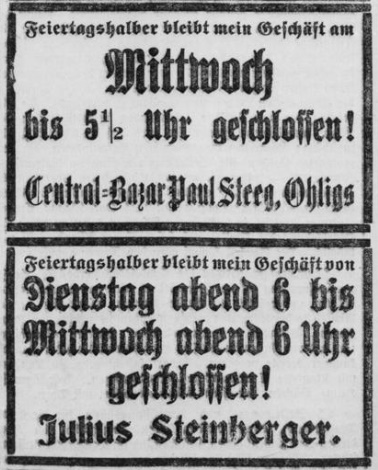
Most of the Jews living in Ohligs were faithful worshippers and members of Solingen’s synagogue community. Some of them even fulfilled functions in the religious community’s council or other committees. Up to the 1920s, Jewish businesses indicated via the local press when they would remain closed during holidays such as Rosh Hashanah or Yom Kippur. Therefore, the religious affiliation of the shop owners was very well known to the clients in Ohligs.
The National Socialist’s antisemitic propaganda did not spare the people in Ohligs of course. Even before 1933, the NSDAP started hosting events that targeted and denigrated Jews. Despite Nazi Germany’s call to boycott Jewish businesses, many of Ohligs’ residents kept faith with the local merchants. However, the “Kristallnacht” in November 1938 meant the ultimate escalation of the situation. The remaining businesses along Düsseldorfer Straße were the first targets of the ruthless Sturmabteilung and Schutzstaffel squads that smashed stores to pieces and terrorised families.

Once again, Ohligs’ train station became a turntable, this time for emigration. Especially the younger generation that still had the chance of rebuilding their life elsewhere left Germany behind and went to the USA, England or South America. For those who weren’t lucky enough to have relatives abroad vouching for them, fleeing to Belgium was, in many cases, the only option left. Germany closed the borders in 1941 and started the deportations towards the east; several Jews from Ohligs were among those murdered in the ghettos and extermination camps. Some of the transports are likely to have been handled via the station in Ohligs. Apart from Enrique Bassat, none of the emigrants ever returned to Germany.
Ohligs‘ Düsseldorfer Straße still is a lively shopping promenade. Nowadays, you will find several Stolpersteine along the way, commemorating the persecuted. With this tour we also want to remember those who have not yet received a Stolperstein as they managed to emigrate in due time. They, too, were disenfranchised, persecuted, and expelled, and should not be forgotten.